"Focus on what you CAN control... stop worrying about things you can't change"
Ugh.... is it just me, or does that always sound like you are being patted on the head and being told to go stay in your lane?
Here’s how I read it:
You're small. You can't change the way things are. Here's a box, stay in it
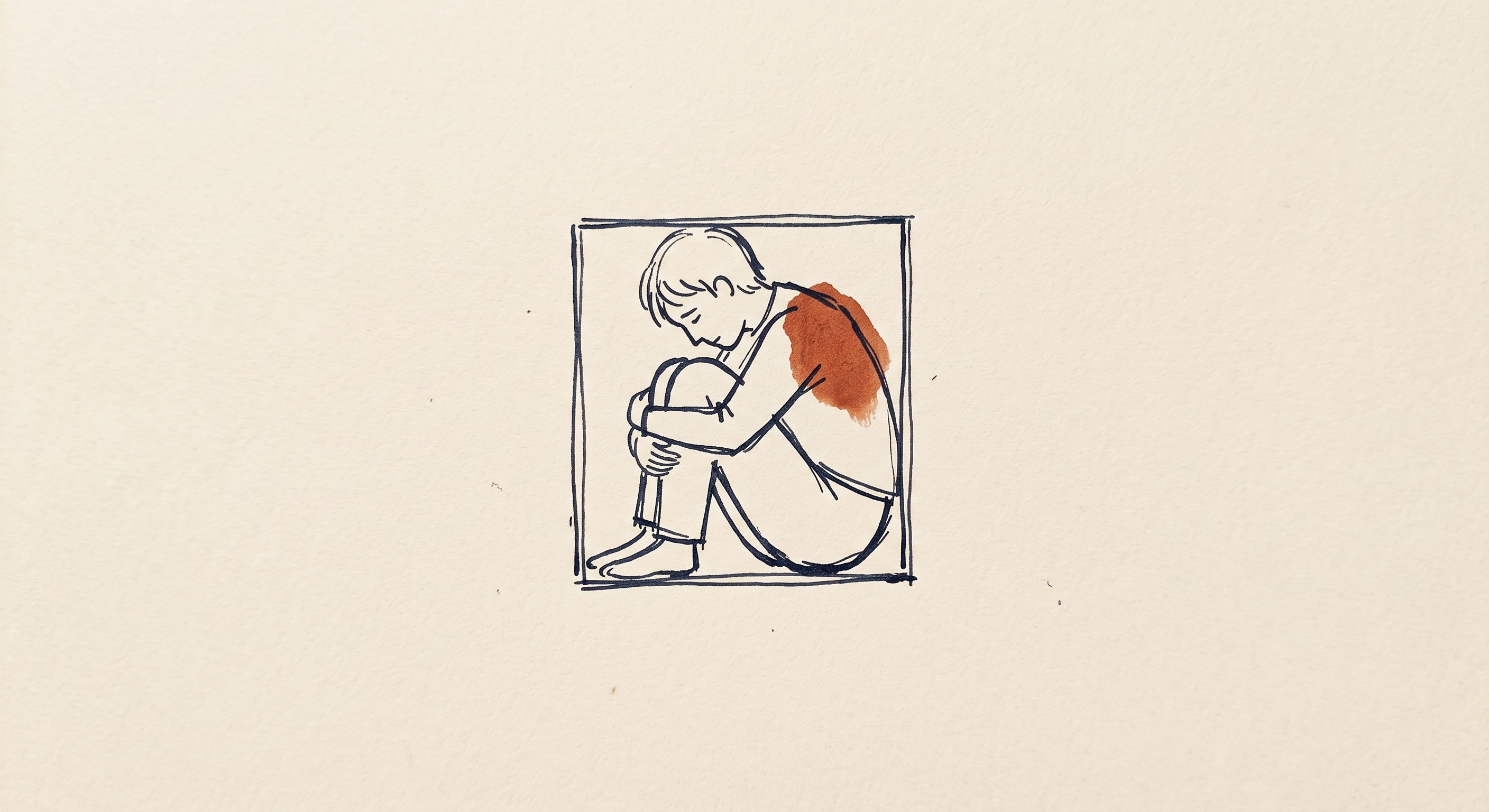
You know what it's like.
You hear it when your world is on fire, or you can see the match about to be struck. You know you could help change things but you don't have the influence or clout.
And it comes from people who would hand you a self-help book to help with your anxiety, just before they recommend you "journal about it" or "meditate" and let it go.
But you were born a visionary, and you see what others can't... I'm going to show you how to harness it.
"Some things are within our power, while others are not. Within our power are opinion, motivation, desire, aversion - in a word, whatever is of our own doing."
Stephen Covey’s Circle of Concern and Circle of Influence from The 7 Habits of Highly Effective People
For so long, I'd always seen it as a way for institutions and societies to remind you that you are small, insignificant, and cannot change the world.
I'd also experienced this many times in roles where I saw problems and recognised solutions others couldn't see, but when I brought them up, I'd been shot down and/or told "It's just the way things work here"
The point, is that the framework that was supposed to reduce anxiety actually created a different anxiety.
Learned Helplessness Dressed Up As Wisdom.
You are told to accept what you cannot control. But the unspoken message, really, is:
Don't try. Don't push. Don't reach. The system is bigger than you.
And the more you internalize that, the more your actual influence shrinks... because you stop attempting things that are at the edge of what's possible.
Covey, in all transparency, DID warn us about this:
Reactive people focus on the Circle of Concern - they obsess over what they can't change, and their Circle of Influence contracts. But the framework was never meant to be a cage.... though it definitely got taught that way.
NOW... There is a way to read this framework that flips it entirely...
Not as a lesson in limits... but as a lesson in leverage.
Ready?
The Circle of Influence is not a cage... it's a compass of your heart.
Yeah yeah, it sounds mushy right?
This is the version I was taught. But not from some self-help book, and definitely not in a corporate training session
I was taught this in a fundraising apprenticeship lesson.
In fundraising, you cannot control whether someone writes a cheque or not. If you try to, you'll go mad, constantly trying to walk a tightrope between morals and manipulation.
You cannot control the economy, their mood, their priorities, or their spouse's opinion. (I've learned through 13 years of marriage I can't control my own wife's mood or opinion, so Lord help me with someone else's...)
BUT.
You CAN control: the quality of your own preparation, the clarity of your story, the depth of your listening, the timing of your follow-up. So those things - done well - will dramatically influence the outcome.
The circle isn't a wall. I needed to get my head around this... instead, it's a map of where your effort has the most leverage.
Using the Circles of Influence framework moves a fundraiser from anxiety and inaction to productivity. Focusing on the Circle of Concern wastes time and energy on things you can't change. When you focus on issues in your Circle of Influence, your actions improve relationships and results. This expands the circle, giving you more influence and control."
Every ounce of energy you spend on what you cannot control is wasted. Every ounce you spend on what you CAN control compounds. The framework is not about accepting less. It's about directing your force into the point of highest impact.
The three domains where the reframe can change everything
Let's now look at some examples of this in action.
In Work
So you can't control whether or not your company WOULD ever promote you. Or whether your industry gets disrupted, or even if your boss COULD like you or not.
BUT... you can control: the skills you build, the reputation you earn, the relationships you invest in, and the quality of the work you do.
Can you see how these are levers? - PULL THEM.
In relationships
You cannot control if someone has the potential to feel positive or negative about you. Whether someone is going to forgive you or not, or whether they stay with you or not.
BUT... you can control: how you show up, how you communicate, whether you apologise without hedging, and whether you do the work to understand them.
Can you see how the influence follows the action?
In the world
You cannot stop the news cycle, or fix the political system, or reverse wars.
BUT... you can control: where you put your money, who you vote for, what you build, what conversations you start, and which local problems you solve.
The people who actually change things do not wait for permission. They find the edge of their circle, and push.
The tension between the boundaries of the circles.
One note here. Before we get into this any deeper.
Did you notice that line just then? - "They find the edge of their circle and push"
You can also align the circle of influence barrier with the comfort zone.
Dan Koe speaks about the two states of progress: Boredom and Anxiety.
When you are in a state of boredom, you are not aware of a problem. Or, at least not one you believe you have the ability to do anything about.
Compare that to being in a state of Anxiety. A little anxiety fuels you to find a solution and is very healthy. Lots of Anxiety happens when you are focused on a huge problem you have no idea how to solve.
Take that and think about it. Then compare it to those domains and the reframes.
I would argue that the pushing of the boundaries of influence is exactly the same state as pushing the boundaries of the comfort zone, where you tread slightly into the realm of that sweet spot of slight anxiety.
A Calmer and More Effective Way of Being
Look at those reframes and realise you can choose to be calmer, you can choose to be more effective as an individual in everything you do once you "get it"
You can stop spraying effort across everything you are worried about. Stop living fully in the circle of concern, thinking you are in the circle of control. Those people are not calm or effective.
You have that choice.
Once you do, you stop doomscrolling as if "Staying informed is the same as doing something"
You'll stop arguing with strangers about things neither of you can change.
Instead, you'll identify the three things you can actually move, and move them. Every day.
The result is not just less anxiety, but you'll find it's more output, more impact and a reputation for being the person who actually gets shit done, while everyone else is still complaining and putting blame on external things that they can't control.
Elephant in the room
So... cool, but the question is not whether this reframe makes sense. It obviously does. The question is:
How do you actually apply it when the world feels loud and the pull towards the Circle of Concern is constant?
Well here is the method I was taught - and how I've taught others - so you can start using it today.
The Core Tool - A Two Column Split
The reframe above is useless without the tools. Here is one I was given.
Draw a line down the middle of a page.
Label the left column "What is MINE". Label the right column "What is NOT MINE"
That is it. That is the entire operating system.
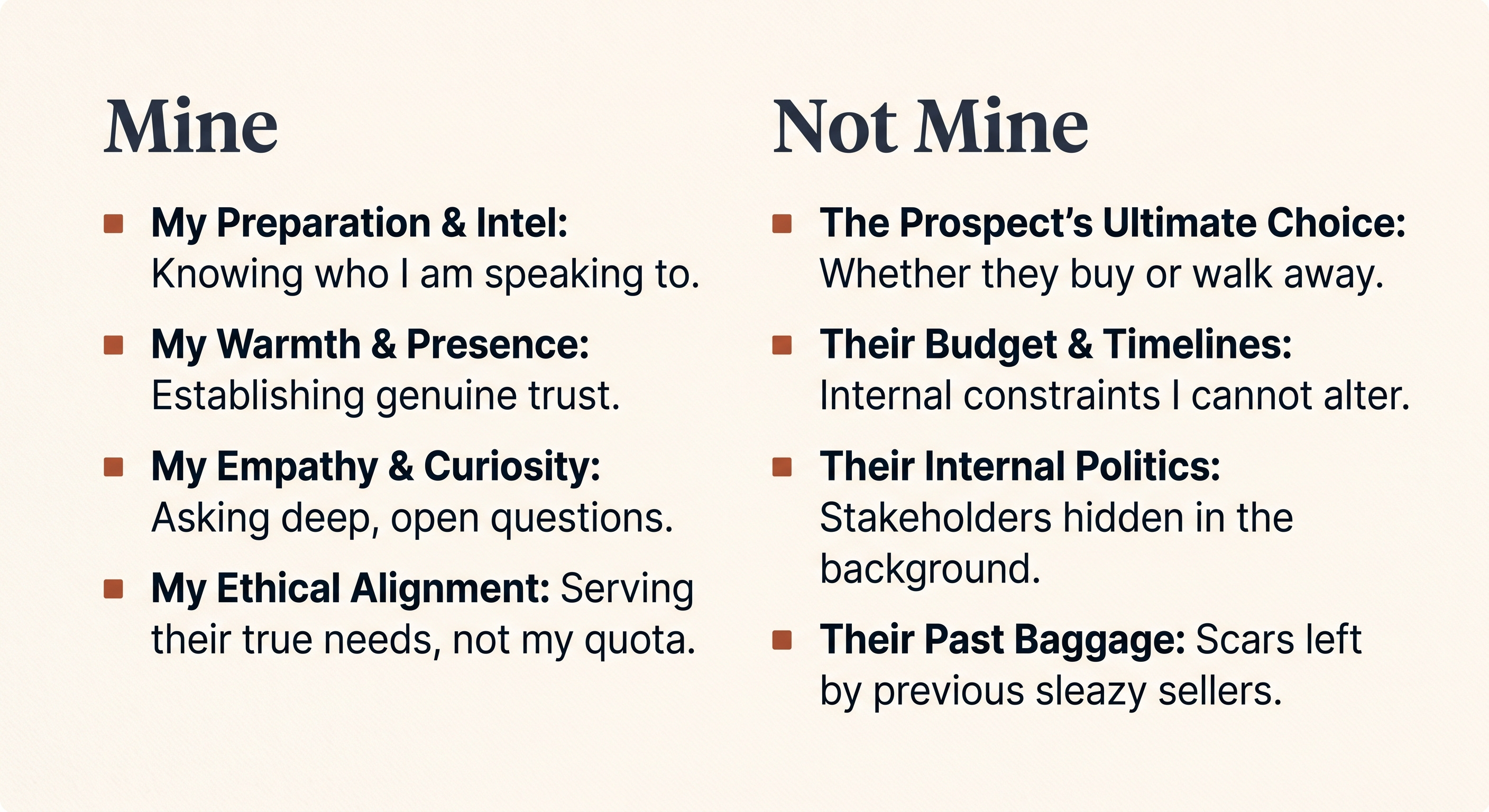
This is not a philosophy. See it as a sorting mechanism, from your head to the paper. It forces you to name, line by line, what you are actually carrying - and - what you are carrying that was never yours.
The 5 Steps from "Worry" to "Action"
So here is how you actually run it.
I want you to pick just one thing, JUST ONE, that keeps you up at night. Maybe it's a stuck deal. A silent and ghosted prospect. Maybe it's a relationship that feels frozen.
STEP 1: Write their name at the top of the page.
STEP 2: List every single worry, frustration, or fear you are carrying about the situation. Do not edit. Do not filter. The uglier, the better. I want you hesitant to admit it on paper, if that's the feeling, you are doing it correctly. Because then it's real! - "I don't know if the CEO likes me. Maybe I said the wrong thing on the last call. What if my price is too high?" Just dump it on the page.
STEP 3: Draw the line. Sort every worry into one of the two columns: What is MINE. What is NOT MINE.
STEP 4: Strike through everything in the right column. THICK marker. BLACK LINE. You are not allowed to carry it anymore. Explicitly commit to not wasting one more ounce of mental energy on those points.
STEP 5: For the items in the left column - the things you actually control - write down one.... specific service-oriented action... you can take in the next 24 hours. Not a vague intention. A. Single. Move.
One action could be:
Instead of sending a pushy follow-up (trying to control the situation), send a highly targeted resource solving a pain point they mentioned on your last call (focusing on your control to add value)
NOTE: Most people stop at "let it go". That is only half of my instruction. I've seen it before in digital sales. My new team member would nod along, but then never actioned the "what he can control". The audit is deceptively simple. The point of doing this forces you to replace the worry with an ACTION. The energy has to go somewhere. Channel it into the column that you own with movement.
Why it works
See... If you are still thinking "this is stupid and too simple"... stop and read.
There is a reason this exercise lands differently, when done properly, than just reading a tweet that says "focus on what you can control"
The act of striking through the right column is not simply organisational. It is emotional. It is something like a ritual of surrender. Does that make sense?
You are looking at a list of things you have been carrying - some of them for a long time - and you are physically crossing them out.
You are admitting, in that ink, that you were never the one holding onto them.
And the wave of relief that is going to follow is not just
"I feel better"
...it is a cognitive bandwidth returning to your system. The energy that was bound up in those worries is now free. You can think again. YOU CAN ACT AGAIN.
This is why the framework was never meant to be a cage in the first place. It was meant to help you release unnecessary energy. Like a release valve.
The circles were never a problem. How people use them is.
This works beyond sales
The audit exercise above was built for stuck deals, conversations that feel out of your control. But it scales to every domain of the 3 earlier in this article.
A STUCK CAREER DECISION
Left column - update your portfolio, have three honest conversations, research the salary range.
Right column - whether the hiring manager likes your vibe, whether the internal candidate has an edge, whether the budget gets approved
A STRAINED RELATIONSHIP
Left column - How you are going to show up, whether you listen without defending, whether you apologise without hedging
Right column - whether they forgive you, whether they let you back in, whether they do the work that's needed too
A CREATIVE BLOCK
Left column - write one bad page, ship something small, show it to one person.
Right column - whether it goes viral, whether critics are kind, whether the algorithm picks it up.
Understand, the audit is a universal sorting mechanism. The categories can change, but the mechanics and emotional value of letting go, THEN ACTION, do not.
Your First Audit
You do not need to read this twice.
Inaction is your enemy here. Call it out and do this... if it's as simple as you thought earlier, it won't take you long, and done correctly, will change the way you see yourself.
You don't need to journal about it for a week before you try it. Screw your self-help bullshit.
Pick one thing that is currently tangled in your chest. A conversation you are avoiding. A decision you cannot make. A person whose silence is maybe eating at you.
(I know that feeling working in Business Development...)
Take a piece of paper. Draw a line. Sort the worries. Strike through the column that was never yours.
Then take the one action in the left column.
Today.
The people who do this once are calmer. I've seen it.
The people who do it as a practice are unstoppable.
Not because they have more control than anyone else, but because they have stopped wasting their force on what they cannot move.
Turn up to the room knowing who you are, and stop wearing a mask.
The Farmer
In the Gospel of Mark. Mark 4. A farmer prepares the soil, sows the seed, sleeps, and rises day after day. The seed sprouts and grows - doesn't know how it does. The farmer does not stand over the soil screaming at the seed to grow. He doesn't pull the blade of grass to stretch it and make it grow taller. The growing was never HIS job.